


Pleasanton council approves issuing $345K bond for water system repairs

By Roger Sims
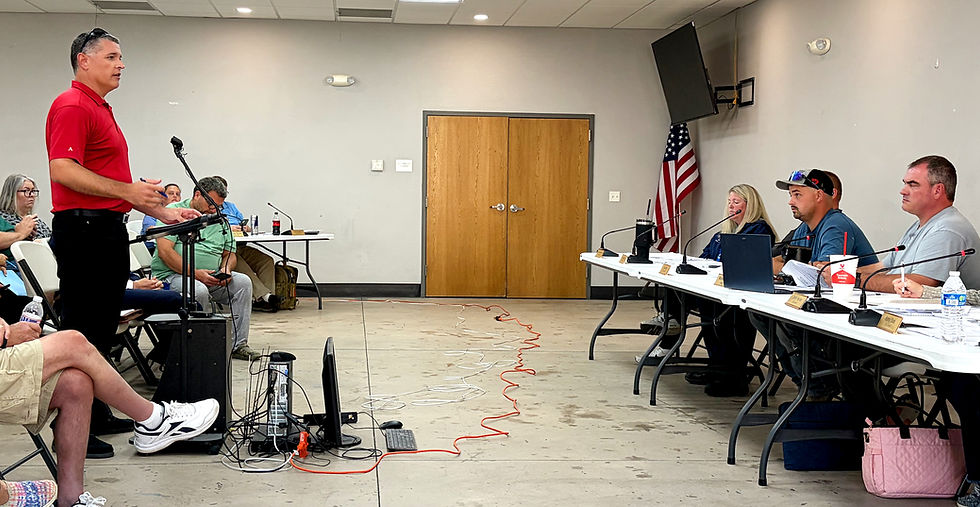
PLEASANTON – The Pleasanton City Council on Monday, Aug. 17, voted to approve a $345,000 bond to finance replacement of the roof at the water plant clarifier and filter building and replace the pumps that send untreated water from the Pleasanton East Lake to the water plant near the Pleasanton school complex.
The bond will pay for the $215,000 roof replacement and the expected $108,000 cost to replace the pumps at the East Lake. The agreement with the city is set up so that each customer of city water will pay an additional $8.87 per meter per month over the next 10 years or until the city either pays off the loan early or makes a refinancing arrangement. Interest rate on the bond will be 5%.
Max McLiney, managing director of McLiney and Co., told the council that the per-customer financing was the only way his company would issue the bonds. Several residents who attended the council meeting suggested setting up payment so that meters that used more water would be more and those that used less water would pay less, but he indicated that wouldn’t be as stable a funding source as the flat fee.
Jason Hoskinson with BG Consultants, the city’s engineering firm, said that work on the roof could begin as early as September and he anticipated that the water plant would only be shut down for a day. The city’s water towers hold more than a day’s supply, and most residents would likely not be affected.

Earlier this year he indicated that the project might not be completed by the end of the year, but on Monday he said the contractor expects to have materials on site in early September.
Last spring, the city council learned that the rafters over the filters were cracked and that a support beam holding up the roof was leaning and threatened roof collapse. City crews were able to correct the support beam, but Hoskinson warned that a heavy snow could still collapse the roof.
If the roof collapses, he said, the city is out of the water business.
Residents attending the meeting questioned the $215,000 price for the roof and indicated that a local construction company could do it for less. They also criticized taking only one bid.
However, when BG Consultants put the project out for bid, no bids were received and at that time Hoskinson said he convinced one of the company’s trusted contractors to do the job.
One of the problems with the project is that the clarifier and filters will need to be protected during removal of the current roof and the installation of trusses and roofing. That will likely include additional construction.
The council also discussed the likelihood of connecting with Public Wholesale Water Supply District No. 13 as a water source. A cost estimate from engineers with PWWSD No. 13 has the cost of that connection at $605,000, a price tag at least one council member found too steep.
Hoskinson pointed out that the city has no backup water supply.
“If anything goes wrong with the plant, you don’t have a water supply,” he told the council.
Even if the city does connect with PWWSD No. 13, it would only be for emergency use only because the wholesale district is near its maximum supply capacity without building more resources, he said.
Councilmember Sandy Haynes asked if the city could reconnect to Linn County Rural Water District No. 2. The city’s plant at one time was connected to RWD No. 2, but Hoskinson said that wasn’t an option. RWD No. 2 is supplied by PWWSD No. 13.
The decision by the council to replace the underperforming pumps at the city lake also removed the city from being able to apply for an emergency grant. However, Hoskinson said that typically those grants only are available when a disaster such as flooding makes the city’s ability to produce potable water impossible.
One member of the audience asked if adding Stegge Lake to the city’s water supply would ease the problem. However, Hoskinson said that Stegge Lake is listed as a recreational lake and the classification with the Kansas Water Office would need to be changed.
He also said that the problem is that the treatment plant would still be the same.
Another audience member suggested that to get emergency grant, the city should just let the roof collapse.
However, City Attorney Jeff Deane said if that happened he would expect for numerous lawsuits to be filed against the city.
Hoskinson suggested that the city first apply to the Kansas Water Office for a technical assistance grant to help pay for engineering costs and information. Once those studies have been performed, the city can them apply for a 50% match Community Development Block Grant for construction. Those grants will be announced next spring, he added.


Comments